
Help with diseases of the spine Bonn
Gentle spine surgery
The neurosurgeons and neurointerventionalists at our practice focus on gentle and efficient operations on the spine. Treatment of the spine in Bonn: Minimally invasive procedures are used whenever medically possible and sensible. For surgical interventions, the neurosurgeons have access to a comprehensive range of high-precision diagnostic and surgical techniques.
Neurosurgery is also characterized by a highly qualified treatment team and the use and development of innovative surgical techniques. State-of-the-art anaesthesia procedures and optimized surgical procedures also ensure low-risk and maximum comfort for patients. Critically ill patients are then closely monitored and optimally cared for in our intensive care unit.
Diseases
We treat the following diseases in our practice (excerpt)
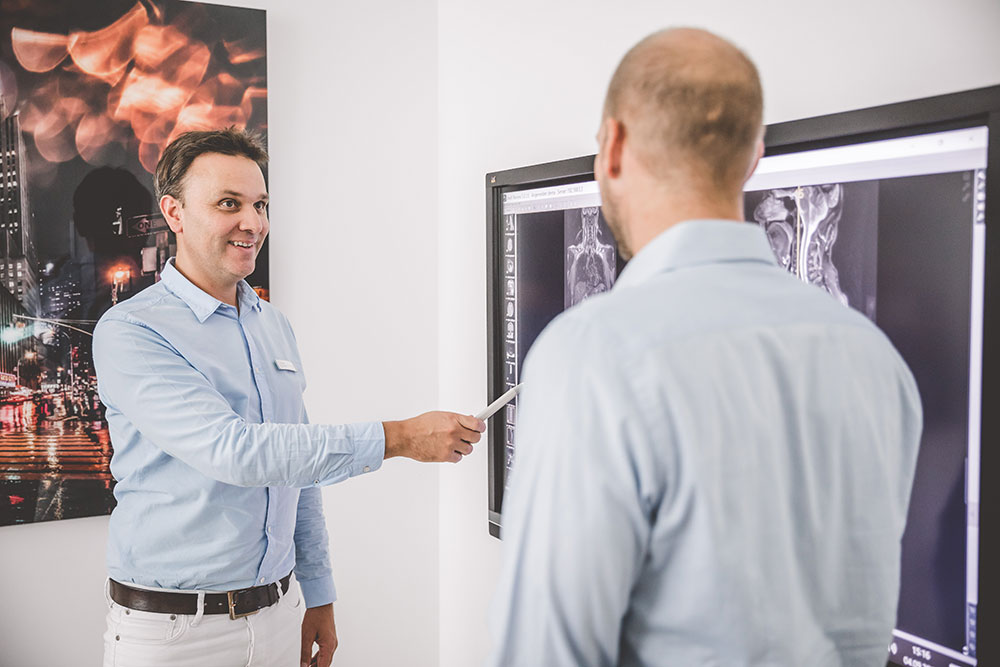
A herniated disc in the spine causes damage to the cartilage ring due to a weakness in the posterior part of the disc. This means that the rear protective ring of the intervertebral disc tears or bulges. This can pinch and irritate nerves (see Figures A and B), causing severe discomfort. Most herniated discs occur in the lumbar and cervical spine.
Spinal canal stenosis and spinal stenosis are used synonymously. As the term spinal stenosis is often more common for patients and interested parties, it is used below.
Spinal stenosis is a narrowing of the spinal canal. This type of narrowing is not distributed evenly throughout the spinal canal, but is concentrated in certain areas of the spine that are subject to heavy strain, particularly at the level of the vertebral joints. The pinching effect causes pressure damage to the nerve roots (see Figures A and B). Spinal stenosis can affect several levels of the spine, particularly in the lumbar and cervical spine. Like most degenerative diseases of the spine, spinal stenosis occurs more frequently in old age.
Slipped vertebrae is the term for an unnaturally mobile vertebra that leaves its normal position within the spine and can therefore cause discomfort. The medical term for a slipped vertebra is spondylolisthesis. A slipped vertebra can cause various symptoms. On the one hand, pain in the back and legs can occur permanently or only during certain movements or postures. On the other hand, a slipped vertebra can cause tingling and numbness and even paralysis.
Osteoarthritis is caused by wear and tear on the joints and can occur as a result of ageing, but can also be caused by overloading or incorrect loading. As a rule, genetic predisposition also plays a role, as our bodies age differently or react differently to stress. A special form is vertebral joint arthrosis. Small vertebral joints – also known as facet joints – are the joints between two vertebrae that are connected by the respective intervertebral disc. This means that there are two vertebral joints (right and left) at each level of the intervertebral disc. In the thoracic spine there are also the rib-vertebral joints, so that there are 4 joints per level. The vertebral joints allow the spine to move, i.e. to turn, stretch and bend.
Back pain can occur as a result of a vertebral fracture, particularly in older people and increasingly in women. In most cases, vertebral fractures are caused by osteoporosis. However, a fracture caused by a tumor or accident can also be present and treated. The symptoms of a vertebral fracture are pain in the back area, which can also radiate to other areas of the body.
Vascular malformations can be, for example, angiomas (congenital or acquired malformations), aneurysms (dilation of the vessel wall), fistulas (unnatural connections between two blood vessels) or vascular ruptures (tears in a vessel wall caused by an accident).
Treatments
Our operational range of services (excerpt)
Endoscopic disc surgery is a minimally invasive percutaneous surgical technique that has revolutionized the treatment of herniated discs. Endoscopic disc surgery is suitable for almost any herniated disc in the lumbar spine, which is treated without damaging the muscles and ligaments. Instead of exposing the spine via an open surgical approach, endoscopic disc surgery uses natural bone openings in the spine to insert the endoscope. This is possible because the instrument is only 7 mm in diameter. The herniated disc presses on the nerve tissue and causes symptoms such as pain or neurological deficits. The herniated disc is removed using an endoscope. This relieves the pressure on the nerve tissue and it is relaxed again after the procedure, which reduces the symptoms.
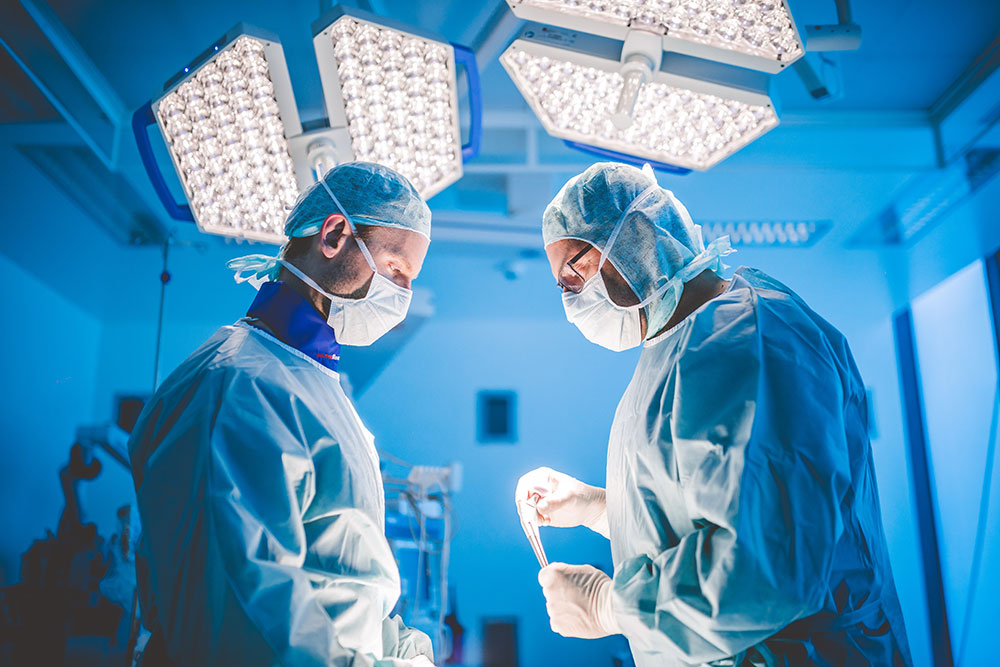
Microsurgery is performed using a special surgical microscope and associated fine instruments. Microsurgery is performed under general anesthesia through the smallest possible incisions. The use of the microscope enables a very precise procedure and provides a high degree of safety. Rehabilitation measures are discussed with our physiotherapists following the microsurgery and can usually be started after one week.
Advantages of microsurgery on the cervical and lumbar spine
- The patient can walk again just a few hours after surgery, as the surgical access is minimized
- The original pain usually disappears immediately after the operation
- Normal physical and occupational activities are possible again just a few weeks later
Another microsurgical procedure is known as decompression. This involves removing the thickened and protruding bone and ligament formations and restoring the normal diameter of the spinal canal. Decompression is a minimally invasive procedure and can also be performed under local anesthesia in individual cases for high-risk patients. As a rule, however, the procedure is performed under a very gentle general anesthetic.
During the prosthesis operation, the diseased disc is replaced by a movable plastic core between titanium brackets. The disc prosthesis is firmly fixed between the vertebrae so that the normal mobility of the adjacent vertebrae is maintained.
Spinal cord stimulation (SCS) is a minimally invasive surgical procedure for the treatment of chronic pain. A so-called neurostimulator or neuromodulator is used. A neurostimulator is a device that is implanted under the skin and sends electrical impulses to nerves. In this way, for example, chronic pain that is resistant to therapy can be permanently eliminated or alleviated. The electrical impulses cause a change in the perception of pain without damaging nerves. You could also call spinal cord stimulation a pacemaker for the nervous system.
Before we perform stabilization/fusion surgery, we first consider all alternative treatment options for chronic back pain, such as endoscopic disc surgery, endoscopic abrasion or disc prosthesis. However, there are certain spinal problems that can only be solved by means of spinal fusion. This applies to patients with a slipped vertebra or patients who have undergone multiple disc operations. For these patients, stabilization/stiffening surgery is often the last resort.
The basic principle of both procedures for the treatment of osteoporotic fractures / vertebral fractures is the creation of one or two tiny drill holes with a special drill and the insertion of liquid cement into the vertebral body. This can be performed under local anesthesia or brief general anesthesia. The cement sets in a few minutes, increases stability and eliminates pain.
The only difference between vertebroplasty and kyphoplasty is that in the somewhat gentler vertebroplasty procedure, the cement is injected into the natural, sponge-like cavities of the vertebra. In kyphoplasty, on the other hand, a balloon is used to create an artificial cavity into which the cement is injected. The results are ultimately identical for both methods.
Microtherapy is a minimally invasive treatment procedure in which patients are treated under local anesthesia using very small instruments and injection needles. Microtherapy is usually performed on an outpatient basis and is largely pain-free. CT and digital X-ray fluoroscopy are used to plan and control the microtherapy procedure. This type of planning and control allows the procedure to be performed with millimeter precision and avoids damaging important anatomical structures and organs.
For less severe stenosis and/or patients for whom surgery under general anesthesia is too dangerous, a spacer, a small interspinous metal implant, can be inserted between the spinous processes of the vertebrae at the level of the spinal canal stenosis as a “minimal” procedure. The spacer leads to a widening of the spinal canal diameter and can already eliminate the symptoms. The percutaneous spacer procedure can be performed on an outpatient basis under local anesthesia.
Embolization is the closure ofblood vessels by introducing vascular-blocking substances or particles. Pathologically altered vessels such as angiomas, aneurysms, fistulas or vascular ruptures can be treated in this way.
We treat aneurysms, which are bulges at weak points in the vessel walls, using a technique known as coiling. The aneurysm is closed from the inside using microcatheters that seal the aneurysm with very fine metal spirals.
Back to all services
Make an appointment now