KneeReviver©: Joint-preserving therapy for knee osteoarthritis

Mechanical distraction – in our practice with biological support

Osteoarthritis of the knee can significantly impair everyday life and mobility. Many sufferers want a way to preserve their knee for as long as possible and regain more stability and comfort in everyday life.

A six-week treatment with the KneeReviver© is a modern, joint-preserving procedure based on mechanical relief of the knee joint. The so-called joint distraction temporarily creates space in the joint and initiates targeted biological repair processes, which can lead to cartilage regeneration even in cases of advanced osteoarthritis.

In our practice, this procedure is combined with regenerative cell therapy (stem cells).
This treatment is suitable for patients under the age of 65 who do not have a severe bowleg or knock-knee deformity.


Known from:

Orthopaedist Dr. Markus Klingenberg with tips against osteoarthritis

New procedure for knee osteoarthritis

How do I get the best treatment for my knee?

Danger from frozen lakes

Osteoarthritis treatment: new method in NRW

Learn more

Modern joint-preserving therapy approaches for the knee

How KneeReviver© works – and when regenerative cells can supplement it

KneeReviver© is a joint-preserving procedure that has been established for over ten years and works exclusively with a mechanical principle: the temporary pulling apart of the knee joint, known as joint distraction.
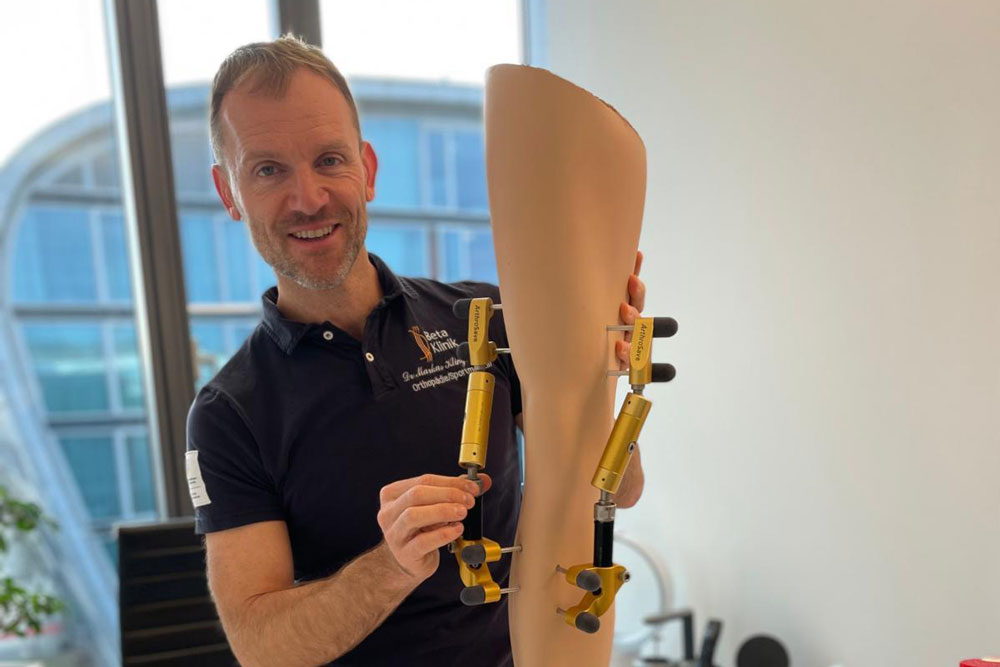
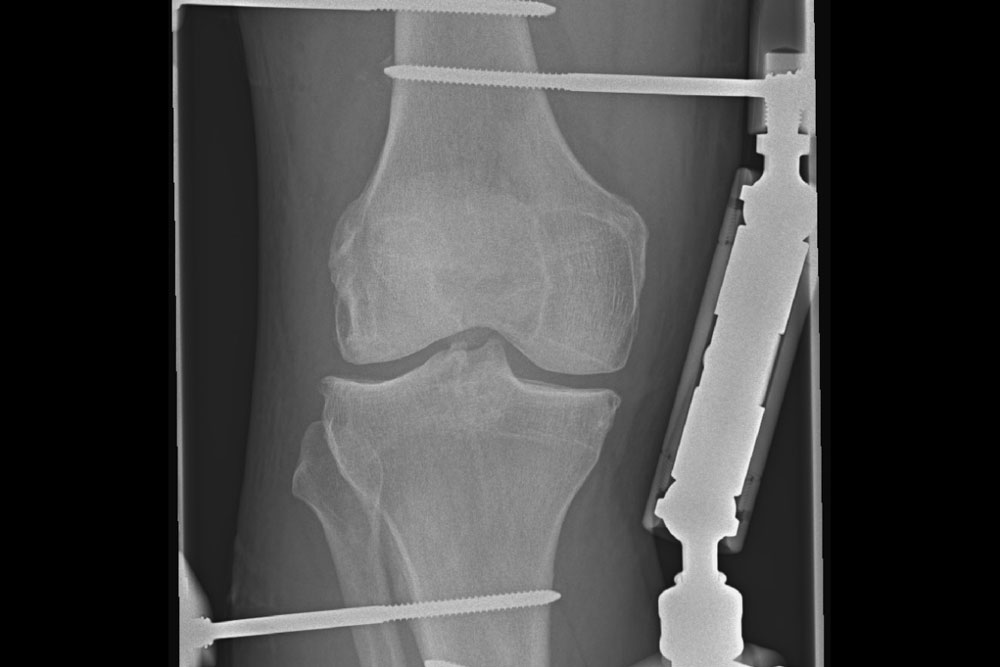
The knee is stabilized by an external system for six weeks and pulled apart slightly, which relieves the joint structures. This process, together with the biological stimulation, can contribute to the joint being able to bear more weight again.

In addition, our practice also offers the option of combining regenerative stem cell therapy. This form of therapy is considered independently of the KneeReviver© and is used when it seems appropriate in the individual case. The cells come from the patient’s own body and can promote the regeneration of cartilage tissue.

KneeReviver© thus offers a structured, joint-preserving approach that can be an interesting alternative to classic joint replacement in suitable indications.
KneeReviver© is aimed at people who have been diagnosed with advanced knee osteoarthritis and for whom conservative treatment measures are no longer sufficiently effective. The procedure is suitable for patients under the age of 65 who do not have a severe knock-knee or bow-leg deformity.
An individual assessment is always important: in a personal consultation, we clarify whether KneeReviver© is suitable for your situation – and whether it makes sense in combination with cell therapy.
  • Mechanical relief: joint pressure is reduced and the cartilage can “regenerate”
  • Biological stimulation: Intermittent pressure changes stimulate the chondrocytes to synthesize the matrix
  • Molecular signals: increase in growth factors (FGF-2, TGF-Beta, IGF-1)
  • Long-term effect: Initial repair phase with subsequent chronic stabilization

The procedure – KneeReviver© in 5 steps

Clearly explained from the first consultation to rehabilitation

1. personal consultation & diagnostics
The first step is a detailed consultation in which your complaints and previous findings are discussed. This is supplemented by a diagnostic examination to check whether the procedure is suitable for your individual situation. The diagnostics include a loaded X-ray/DVT image and a current MRI with cartilage mapping. These examinations can be carried out on our premises.

2. preparation & surgical application of the KneeReviver©
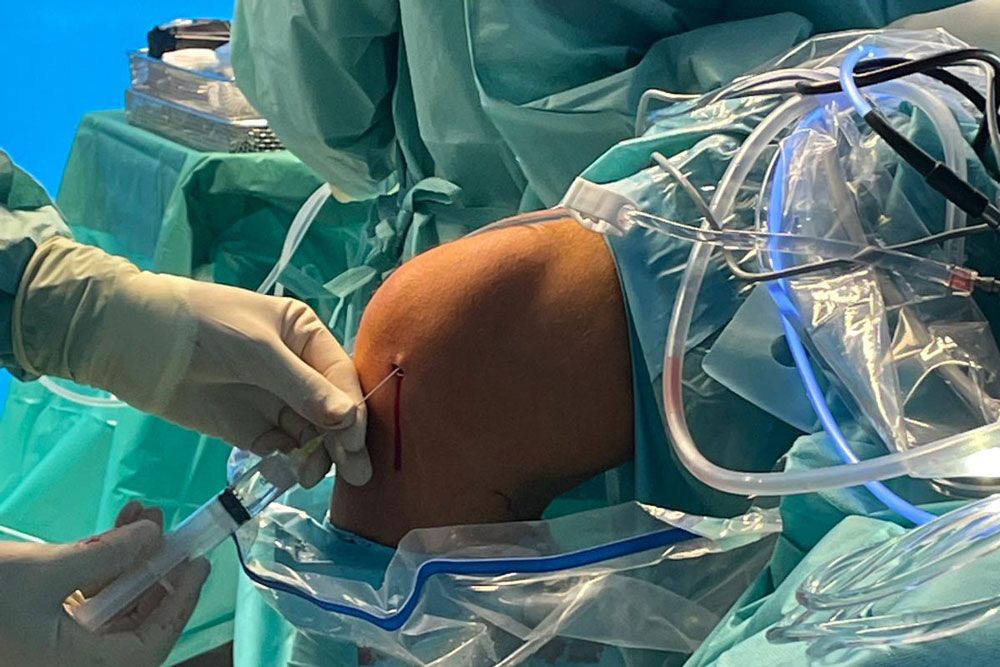
If the requirements are met, the KneeReviver© is fixed to the femur and tibia in a surgical procedure. The two-day inpatient procedure is planned and performed under safe medical conditions.

3rd phase of joint distraction
The six-week distraction phase begins after the implantation. The knee joint is pulled apart by at least 5 mm, which relieves the joint surfaces. The patient can put full weight on the operated leg in extension. Thrombosis prophylaxis is carried out due to the extended position. Regular medical check-ups are carried out after at least one and three weeks. Patients who have to travel a long way can also be checked by a doctor on site.

4. removal of the system & resumption of mobility
Once the distraction is complete, the device is completely removed during a one-day inpatient stay. An imaging check (X-ray / DVT) is carried out on site to assess the condition of the knee joint. This is followed by the phase of gradually regaining mobility through independent exercises and accompanying physiotherapy measures. The time required varies from person to person and is usually around six to twelve weeks.

5. rehabilitation & long-term stabilization
Individually tailored follow-up treatment supports the further development of the knee joint. In addition to personal contact, patients are also accompanied by an app that supports the rehabilitation process.
A follow-up check in our practice takes place after one year at the latest. This involves new imaging examinations (X-ray / DVT) and an MRI examination with cartilage mapping to assess the condition of the knee joint in detail.
Why KneeReviver© in our practice

Experience and specialization in joint-preserving therapy

The treatment of knee osteoarthritis requires experience, precision and a sound individual assessment. In our practice, we combine mechanical and biological approaches with special professional expertise.
We are one of the first practices to combine the KneeReviver© procedure with regenerative stem cell therapy. This combination is not standard, but is used deliberately and individually. Stem cell therapy is assessed independently of the KneeReviver© and then supplemented if it appears to make medical sense in the respective case. The cells used come from the patient’s own body and can support regenerative processes in the joint.

Dr. Klingenberg has many years of experience in regenerative medicine and has performed over 1,700 stem cell treatments as of January 2026 – making him one of the most experienced practitioners in Germany.

Another special feature of our practice is cartilage mapping, which enables a differentiated assessment of the condition of the cartilage and makes treatment planning much more precise. This diagnostic depth is only offered by a few facilities.
  • Preservation of your own knee joint: KneeReviver© works by preserving the joint. The natural knee remains intact, including the patient’s own coordination, perception and movement sequences. An artificial joint, on the other hand, often feels different and changes the natural sense of movement.
  • More suitable for younger, active patients: Under the age of 65, there is an increased risk that an artificial knee joint will wear out more quickly due to high levels of activity. As KneeReviver© does not require an implant, there is no risk of material failure.
  • Avoidance of revision surgery: An inserted implant may need to be replaced at a later date. These revisions usually achieve less good functional results than the initial procedure. KneeReviver© avoids this problem, as no artificial material is inserted.
  • More flexibility for the future: If you decide to have a joint replacement at a later date, this is still possible. KneeReviver© does not restrict future treatment options. With a prosthesis, however, all joint-preserving therapies are permanently discontinued.
  • Activity level and everyday life: As the patient’s own joint is preserved, many patients report a more natural body feeling and good integration into everyday life. Although an artificial knee enables activity, it can set limits in some cases.

These points make KneeReviver© particularly attractive for people who want to preserve their knee joint for as long as possible and at the same time attach importance to long-term mobility and flexibility in therapy planning.

FAQ about KneeReviver©

Frequently asked questions and answers
The procedure is ideal for patients diagnosed with knee osteoarthritis when conservative therapies (physiotherapy, medication, etc.) are no longer sufficient. It is usually considered for people under the age of 65 who do not have a pronounced knock-knee or bow-leg deformity.
Joint distraction with the KneeReviver takes around six weeks. During this time, the knee is immobilized – in other words, the joint is relieved by pulling the joint surfaces slightly apart. Weight-bearing may be permitted, but bending the knee is not possible. The system is then removed and the knee is slowly mobilized and rehabilitated.
Yes – in many cases, full weight bearing is permitted. However, the knee cannot be flexed during this time. Mechanical release is an essential part of the procedure and is checked regularly by a doctor.
Yes, if the knee joint deteriorates significantly again in the further course of the disease, a knee prosthesis can still be implanted. The KneeReviver© procedure does not rule out this option and in many cases can even buy time before an artificial joint becomes necessary.
Studies with follow-up periods of up to ten years show that knee joint distraction can lead to a sustained reduction in pain, improved joint function and a delay in knee replacement in many patients. In many cases, the patient’s own knee joint can be preserved for years.

To the study: https://arthrosave.com/science/?lang=de#Jansen-2022

The procedure has been the subject of studies for more than ten years. The results show structural improvements in the knee, pain relief and functional improvements in many patients.
With careful indication and medical supervision, it is a medically sound alternative to a prosthesis – especially for younger or active patients.

To the study: https://arthrosave.com/science/?lang=de#Jansen-2022

As with any surgical treatment, there are risks – particularly due to fixation to the bone (bone pins), possible infections or difficulties with healing and stabilization. The procedure and treatment require conscientious medical supervision and rehabilitation.
Studies show that many patients show structural improvements in the joint – e.g. an increased joint space width and evidence of joint tissue regeneration after distraction.
Nevertheless, long-term success depends heavily on individual factors – e.g. age, load, joint condition and follow-up treatment.
After the KneeReviver© has been fitted, follow-up appointments are scheduled after approximately one week and after three weeks. These appointments take place in person at our practice and serve to medically review the course of therapy and adjust further treatment.
Treatment with KneeReviver© is generally only covered by private health insurance. For those with statutory health insurance, the treatment is currently a self-payment service. The costs are between approx. 15,000 and 18,000 euros, depending on the individual treatment required. An exact estimate will be made in a personal consultation.
While wearing the KneeReviver©, we recommend wearing loose, comfortable clothing that offers sufficient space for the frame. For example, dresses, wide training pants or loose-fitting linen pants are suitable. This makes everyday life and exercise as comfortable as possible.
Driving is only possible to a limited extent. If the left knee is affected, driving an automatic vehicle may be permitted under certain circumstances. During the distraction phase, the leg can only be fully loaded in an extended position and cannot be bent.
The individual perception of pain can vary. Overall, the postoperative pain level is often described as rather low. Accompanying pain therapy is needs-oriented and individually adapted.
Upper body exercises are generally possible during the distraction phase. After removal of the system, sporting activity can be gradually resumed in full.
On request, there is the option of targeted, supervised training on site, which is individually tailored.
Your next step – personal consultation on KneeReviver©

Knee joint distraction is considered a modern, joint-preserving approach for advanced knee osteoarthritis. For younger patients, it can be a scientifically proven alternative to early knee replacement and can delay joint replacement for years.

Long-term data with follow-up observations of up to ten years show that the observed regenerative effects may be more permanent than previously assumed. If you would like to find out more about KneeReviver© in relation to your individual situation, we would be happy to advise you in a personal consultation.

Make an appointment and receive individual support – transparent, understandable and tailored to your needs.


Back to all services

All services

Make an appointment now

Contact us